
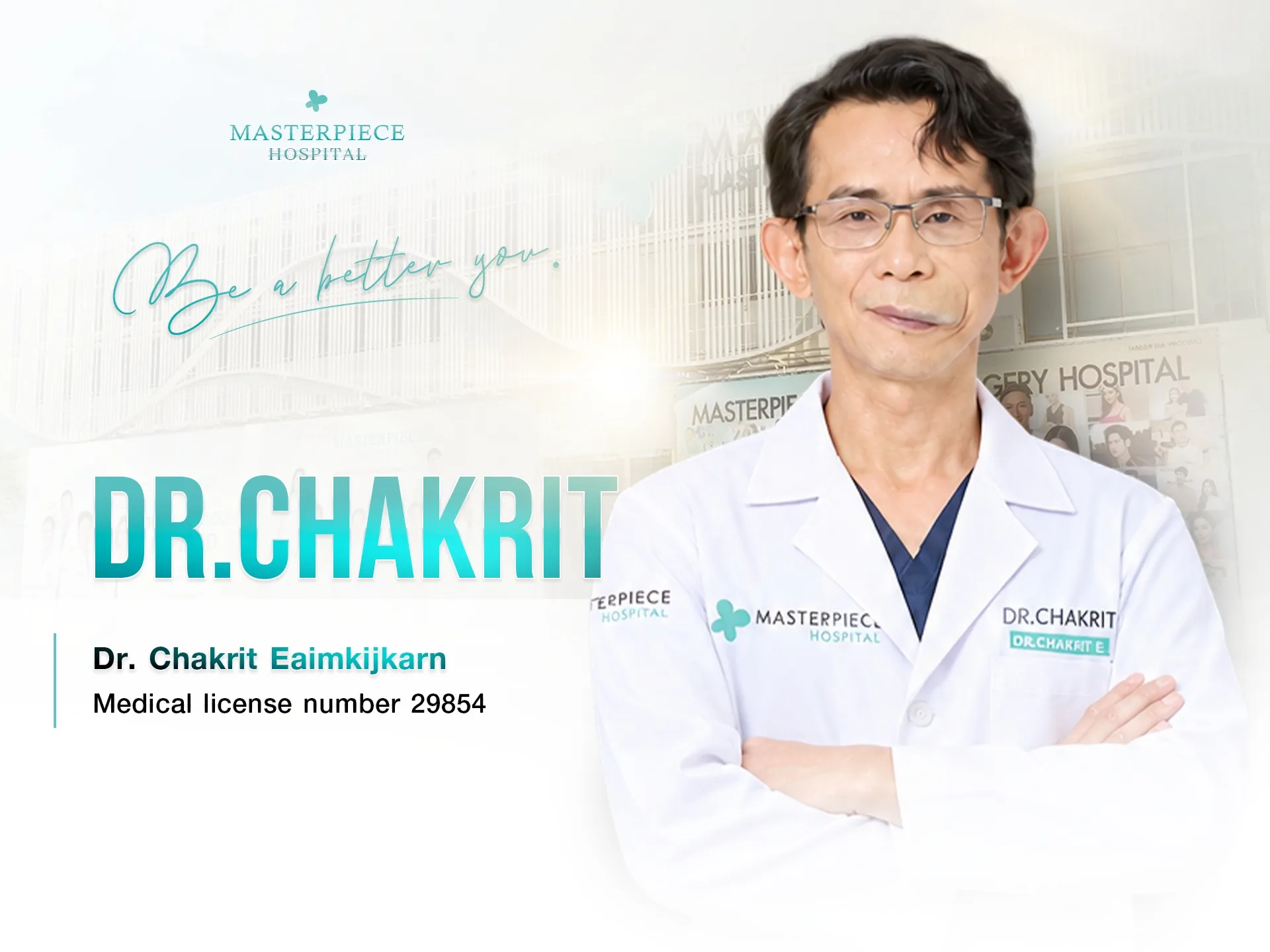
DR. Chakrit Eaimkijkarn (DR. Chakrit)

─── ABOUT THE DOCTOR ───
Background and inspiration
Why did you choose to specialize in plastic surgery?
Dr. Chakrit: Let me share one case. It involved a woman in Samut Sakhon Province who worked as a shrimp farm caretaker. While she was checking the water aerator, her hair got caught and pulled, resulting in complete scalp avulsion. When the patient arrived at the hospital, I was a fifth-year medical student. I felt that this was a very unfortunate case and wondered what could be done. Her skull was exposed and needed to be covered, so I had the opportunity to participate in the case. The surgery lasted from 8:00 a.m. to 1:00 a.m.
In this case, tissue from the upper back was transferred along with its blood vessels for transplantation. I was deeply impressed because it showed the remarkable capabilities of plastic surgery. We were able to transfer tissue from the patient’s back to the head to cover the exposed skull and help the patient survive.
Was there any inspiration, turning point, or event that made you passionate about this field?
Dr. Chakrit: It is a field with something special that sets it apart from others. We may spend just 2, 4, 6, or 8 hours performing surgery, but we can change someone’s life and help them become more confident.
Philosophy and approach to patient care
When a patient comes in for a consultation, what principles or approach do you prioritize when evaluating them?
Dr. Chakrit: Something I have always kept in mind is that whenever I make a decision about performing a procedure for a patient, I always think of that person as my younger sibling, father, older sibling, or relative. I would treat them the same way I would treat my own family members.
How do you define beauty or the best possible outcome from your perspective?
Dr. Chakrit: Because everyone’s perception of beauty is different, my definition of beauty is more about the patient’s satisfaction and confidence. However, the fundamental priority must always be safety.
Areas of expertise and techniques
What challenges do the procedures you currently perform present?
Dr. Chakrit: The procedures I perform can be divided into two groups: medical treatment and aesthetic surgery. In terms of medical treatment, one of the challenges in my career is performing microsurgery to connect blood vessels. I am proud that relatively few people in Thailand perform this type of procedure.
For aesthetic surgery, the challenge is that each person comes with different concerns. This is especially true for patients with breast asymmetry, such as breasts that are different in size. The challenge is finding techniques to adjust everything so that the two sides are as similar as possible, because there are two breasts.
Tummy tuck surgery is another type of challenge because many women seek this procedure after losing weight or having children. Patients who come to see me often say, “It’s because I had children that I became this way. My breasts have sagged and my abdomen has loose skin.” I never want them to think that way. Therefore, the challenge for me is to help them regain their confidence.
During surgery, are there any special techniques you commonly use to achieve the best possible results, minimize bruising, or promote faster recovery?
Dr. Chakrit: It is important to have a clear view of the surgical area. Sometimes, we need to use a camera to assist during surgery so that we can clearly see everything—for example, whether the bleeding has been properly controlled, whether the tissue has been adequately released, whether the area has been fully loosened, and whether we are working in the correct tissue plane.
Areas of expertise and procedures offered
Breast surgery, including breast augmentation and breast lift surgery
Tummy tuck, for patients with loose or sagging abdominal skin
Tummy tuck
Q&A with Dr. Chakrit
If a patient is very afraid of surgery, what would Dr. Chakrit like to tell them?
It would probably be impossible to tell them not to be afraid, because fear is natural for everyone. What they should do is carefully choose and research the doctor who will perform their surgery. Choosing a doctor with the appropriate expertise can help achieve good outcomes, both during and after surgery.
If a patient brings in a photo of a celebrity or influencer and says they want exactly the same look, what would you do?
Many times, I would ask the patient to find a photo showing the look they want. However, I would advise them to choose someone whose body shape or physical structure is similar to their own, so that I can assess the appropriate implant size.
Is there anything you would like patients to know before deciding to undergo plastic surgery?
They should know who their doctor is. These days, I think it is quite easy to check a doctor’s background. You can search for their name through the Medical Council of Thailand and find information about who they are, where they graduated from, and their areas of expertise.
The next thing is the hospital. What is important is that the hospital must have a team in place to provide support, because complications can occur during surgery. Even though they may not happen often and may only occur occasionally, everyone needs to be prepared.

Details of the Physicians at Masterpiece Hospital
Educational Background
- Department of Surgery, Faculty of Medicine Siriraj Hospital ( Surgery ) ( Plastic Surgery )
- Licensed to practice medicine since 2003
- Medical License No. 27220/2014 (Plastic Surgery)
- Medical Professional License No. 29854
Medical Procedures Specialist
- Breast Surgery Department
- Rhinoplasty Department
- Skin Removal Surgery Department
Specialized Knowledge and Expertise Certified by the Medical Council
- Surgery
- Plastic Surgery
Training and Professional Development
- Expert Lecturer in Plastic Surgery/Microsurgery, Vajira Hospital
- Expert Lecturer in Breast Plastic Surgery, Masterpiece Hospital