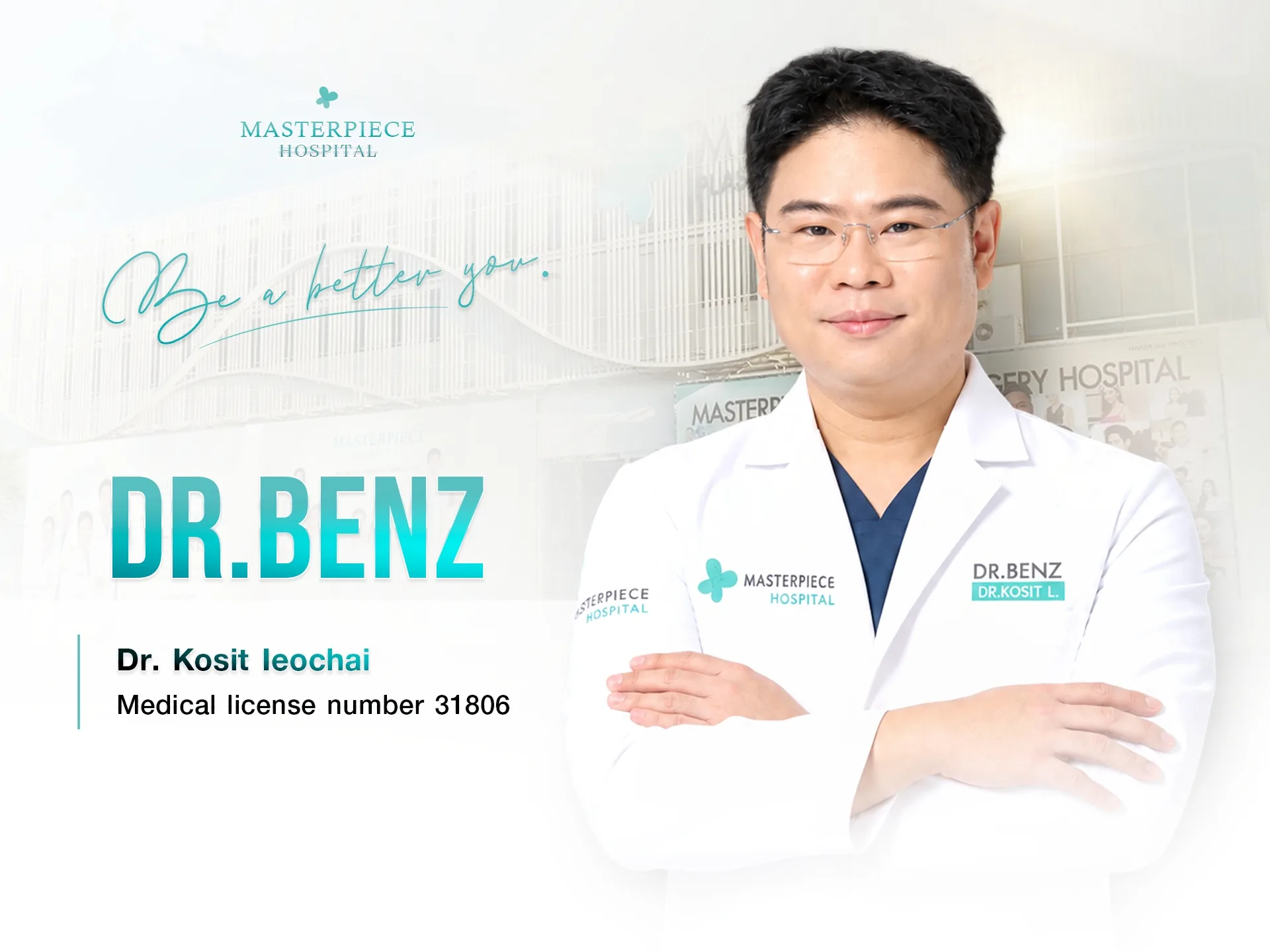
DR. Kosit Ieochai (DR. Benz)

─── ABOUT THE DOCTOR ───
Background and inspiration
Get to know Dr. Benz (Dr. Khosit Eawchai) in depth
I am Dr. Khosit Eawchai, also known as Dr. Benz, an otolaryngologist. Many people may know me from the medical knowledge I regularly share on TikTok, while those interested in aesthetic procedures may know me as a doctor dedicated to rhinoplasty, particularly open rhinoplasty for both primary and revision cases, including the use of the patient’s own rib cartilage. My background in otolaryngology has given me an understanding of both the external structure and internal anatomy of the nose.
For me, rhinoplasty is not solely about changing the appearance of the nose. I place equal importance on aesthetics, safety, and breathing function. What led me to focus specifically on rhinoplasty is the complexity of the nose as the central feature of the face. Even subtle changes can have a significant impact on the overall facial appearance. At the same time, there are many patients in Thailand who require care following complications from previous rhinoplasty procedures using various techniques. Being able to help patients facing these challenges has become an important source of motivation, inspiring me to remain committed to my work every day.
My goal in performing rhinoplasty is not to give everyone the same nose, but to help each patient achieve an outcome that is appropriate for them while supporting their quality of life. Above all, I believe rhinoplasty should be approached with a focus on safety, aesthetics, and long-term results.
Philosophy and approach to patient care
My principle in caring for patients is that safety and aesthetics, breathing, and patient satisfaction must all come together. I believe that good surgery should improve a patient’s quality of life in every aspect.
I believe that a suitable nose should be in harmony with the patient’s face. It does not need to be the most prominent or projected nose possible, but should be within what the tissues can support without unnecessarily increasing the risks.
A doctor’s role is not simply to do what the patient wants, but also to help assess whether what they want is appropriate and safe. If I find that a patient is not yet ready for surgery, has expectations that do not align with the limitations of their body, or wants a shape that may increase the risk to the tissues, I am prepared to postpone or decline the surgery, even if that may not be the answer the patient wants to hear at that moment. This is done for the patient’s best interests, not for the doctor’s.
I want consultations to be a space where patients can ask about anything and understand the benefits, limitations, and risks before making a decision. I believe that a good decision about surgery should come from complete information and a shared understanding between the doctor and the patient.
Specialized expertise in open rhinoplasty and rib cartilage techniques
Why do I primarily choose to use the patient’s own rib cartilage?
I choose to use the patient’s own rib cartilage in cases that require a significant change, as well as safety and long-term durability of the nose. Rib cartilage provides a sufficient amount of material, is the patient’s own tissue, and does not damage the nasal tip.
One of the key benefits is that the doctor can use the cartilage to correct the existing nasal structure when it is crooked, deviated, or has been distorted. This is particularly important in revision cases following semi-open rhinoplasty or cases where the patient has previously undergone open rhinoplasty. If the goal is to achieve a better result than before, it is often necessary to use stronger cartilage to reconstruct the nose, which requires a rib cartilage technique.
However, rib cartilage is not a material that is suitable for every doctor. An important limitation is that if a doctor has less than 5–10 years of experience, errors and complications may occur more frequently. This is one reason why we are now seeing more cases of problems following open rhinoplasty, as more doctors who have only recently completed their specialist training are increasingly performing this technique.
Personal technique for designing the nose shape
Before designing the nose, I begin by assessing the entire face rather than considering the nose as a separate feature. I look at the proportions of the forehead, eyes, cheekbones, lips, and chin, as well as the skin thickness, nasal base, strength of the nasal tip, nasal septum alignment, and the structure of the airway.
I listen to the patient’s concerns and what they would like to change. I then explain what can be done, what limitations may exist, and what type of shape is likely to suit their face, without relying solely on reference images. Even when patients want the same nose shape, each person has different underlying structures and tissues, so the results cannot be exactly the same in every case.
For the incision on the chest, I position it according to the patient’s anatomy and aim to keep the incision only as large as necessary to safely remove the rib cartilage. I also provide advice on postoperative wound care. However, the appearance and visibility of the scar, as well as the recovery period, vary from person to person, and it cannot be guaranteed that the scar will be small or fade to the same extent in every case.
Expertise and procedures offered
My expertise covers rhinoplasty, from primary augmentation to complex revision cases.
Q&A with Dr. Benz
Does using your own rib cartilage hurt?
There may be mild pain or tightness around the incision beneath the breast fold, especially when changing positions from lying down to sitting up or twisting the body. This is particularly noticeable during the first week. However, the level of pain varies from person to person and can generally be managed with medication according to the treatment plan.
The size and position of the incision are concealed within the fold beneath the breast, and in almost all cases, the scar does not become raised.
Can a nose reconstructed with open rhinoplasty and rib cartilage be twisted or touched like a natural nose?
Once the incision has healed and the nasal structure has settled, the nose can be touched and used normally in everyday life. However, you should not intentionally twist, bend, or forcefully move the nose to test it, because a nose that has undergone structural reconstruction may be firmer or less mobile than a nose that has not undergone surgery, particularly around the nasal tip.
My goal is to create a natural-looking shape with a stable structure, rather than make the nose as flexible as possible. The softness or firmness of the nose after surgery also depends on the surgical technique, the amount of cartilage used, scar tissue, and each individual’s underlying tissue characteristics.
Why do severely damaged or significantly deformed revision cases often require rib cartilage?
Revision rhinoplasty cases are often more complex than primary rhinoplasty because there may be scar tissue, distorted existing structures, thinning tissues, or cartilage from the nasal septum and ears may have already been used. Revision surgery may therefore require strong rib cartilage to create a new foundation and provide structural support. It should also be performed by a doctor with extensive experience in open revision rhinoplasty in order to have greater confidence in the outcome.
Can I bring a reference photo of my preferred nose shape and have it made to look the same?
You can bring a reference photo for me to look at, as it helps me understand what level of height, projection, or specific details the patient prefers. However, the reference photo should be used as a communication tool, rather than a guarantee that the result can be made identical in every detail.
Each person has different bone structure, skin, nasal tip tissue, and facial proportions. I will therefore take the features the patient likes and adapt them to their actual nasal structure, while explaining which aspects can be achieved, which should be adjusted, and what level remains within a safe range.
Doctor introduction video
An introduction video featuring Dr. Benz and his approach to patient care
Details of the Physicians at Masterpiece Hospital
DR. Kosit Ieochai
Educational Background
- Faculty of Medicine Siriraj Hospital, Mahidol University
- Medical License No. 12405/2011 (Otorhinolaryngology)
- Medical Professional License No. 31806
Medical Procedures Specialist
- Rhinoplasty Department
- Academic Advisor in the Department of Otorhinolaryngology, Faculty of Medicine Siriraj Hospital, Mahidol University.
Specialized Knowledge and Expertise Certified by the Medical Council
- ( Otolaryngology ) : Otorhinolaryngology (ENT)
Training and Professional Development
- Member, The Society of Plastic and Reconstructive Surgery of Thailand
- (Diploma and fellowship of Korean college of cosmetic surgery) : Diploma in Facial Aesthetic Surgery, Korea. (Diploma and Fellowship of Korean College of Cosmetic Surgery)
- Certificate of participation of “Dallas rhinoplasty” Texas, USA: Certificate of Participation, “Dallas Rhinoplasty,” Texas, USA
- Certificate of attendant of ‘Advanved in Rhinoplasty” Orlando, USA: Certificate of Attendance, “Advanced Rhinoplasty,” Orlando, USA
- Otolaryngologist Medical Doctor, Faculty of Medicine Siriraj Hospital, Mahidol University, Thailand, Department of ENT